

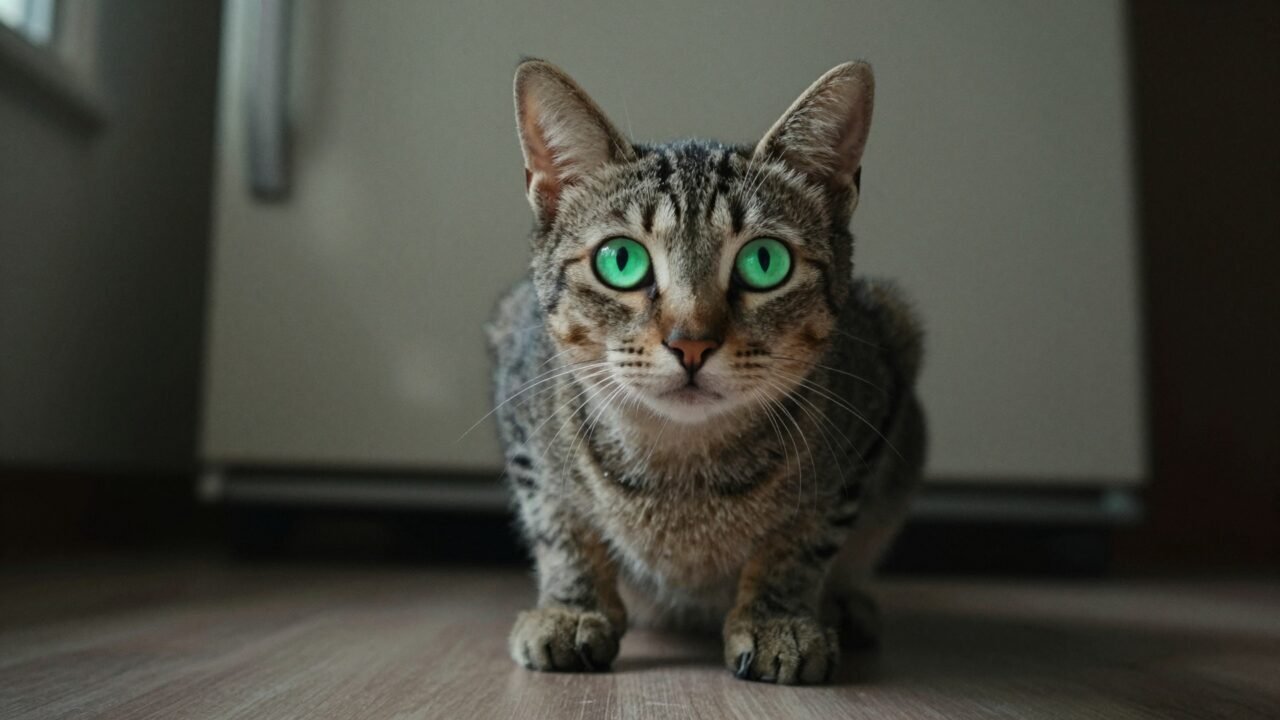
It is 3:00 AM. You get up for a glass of water and, in the dark hallway, two glowing green orbs are staring right at you. It is your cat. And they can see you perfectly, while you can barely make out their silhouette.
This common scenario hides one of the most famous superpowers in the animal kingdom—and also one of the most widespread myths about cats. What your cat does in the dark is truly amazing, but it is not quite what most people think. Let us take a closer look, literally.
The Secret Behind Those Glowing Eyes in the Dark
That greenish glow is neither magic nor a camera flash artifact: it is the visible proof of their superpower. Behind the retina, cats have a reflective layer called the tapetum lucidum, a sort of biological mirror. When even a tiny amount of light enters the eye, it bounces off this mirror and passes through the light receptors a second time. It is like giving every single photon two chances to be used. That reflection is precisely what you see glowing in the dark.
Add to that a retina packed with rod cells—specialized cells designed to capture dim light and movement—alongside pupils that dilate wide to swallow up every last bit of light. The result: a cat needs about six times less light than you do to see. Where you see pitch black, they see a dimly lit room that is perfectly easy to navigate. But watch out for the phrase "dim light," because that is where the catch lies.
The ability to see in the dark is largely due to the tapetum lucidum and the high concentration of rod cells in the retina. This allows them to amplify available light, resulting in much more effective vision in low-light conditions. However, this adaptation comes with a trade-off, as we will see shortly.
🔎 MYTH: Cats can see in total darkness.
✅ REALITY: False. In absolute darkness, without a single source of light, a cat is just as blind as you are. Their eyes do not create light; they amplify whatever minuscule amount is already there. Without any light at all, there is nothing to amplify.
The Price of Low-Light Vision
Here is what almost nobody tells you: that nocturnal superpower comes at a cost. By packing their eyes with rod cells for night vision, cats sacrifice cells dedicated to color and sharp detail. The consequence? Your cat sees a world that is less colorful and blurrier than what you see during the day.
It is true that they distinguish far fewer colors than we do and struggle to focus on sharp details at a distance. But in return, they can detect the slightest movement in the shadows: a mouse twitching, an insect's wing fluttering, or your foot moving beneath the bedsheets. Evolution designed them as crepuscular hunters, built for the times when prey comes out and light is scarce. They traded technicolor vision to ensure they never miss movement in the dark.

Cat night vision is a fascinating example of how evolution optimizes animal capabilities for a specific environment. In this case, the ability to see in the dark makes them highly effective hunters in low-light conditions, even if it comes at the expense of color perception and fine detail.
Your cat is not a nocturnal superhero. They are low-light specialists who gave up color and sharp focus to ensure they never miss a single movement in the dark.
One crucial note: because cats rely so heavily on their eyes, any noticeable change—a cloudy eye, bumping into objects, or misjudging jumps—warrants a trip to the vet. It is not always just old age; sometimes it is a treatable condition if caught early enough.
And if you love figuring out what your cat is doing when you think they are just hanging out, there is another subtle behavior full of hidden meaning: discover what they are really telling you when they decide to sleep right on top of you.
The Importance of Vision for Cats
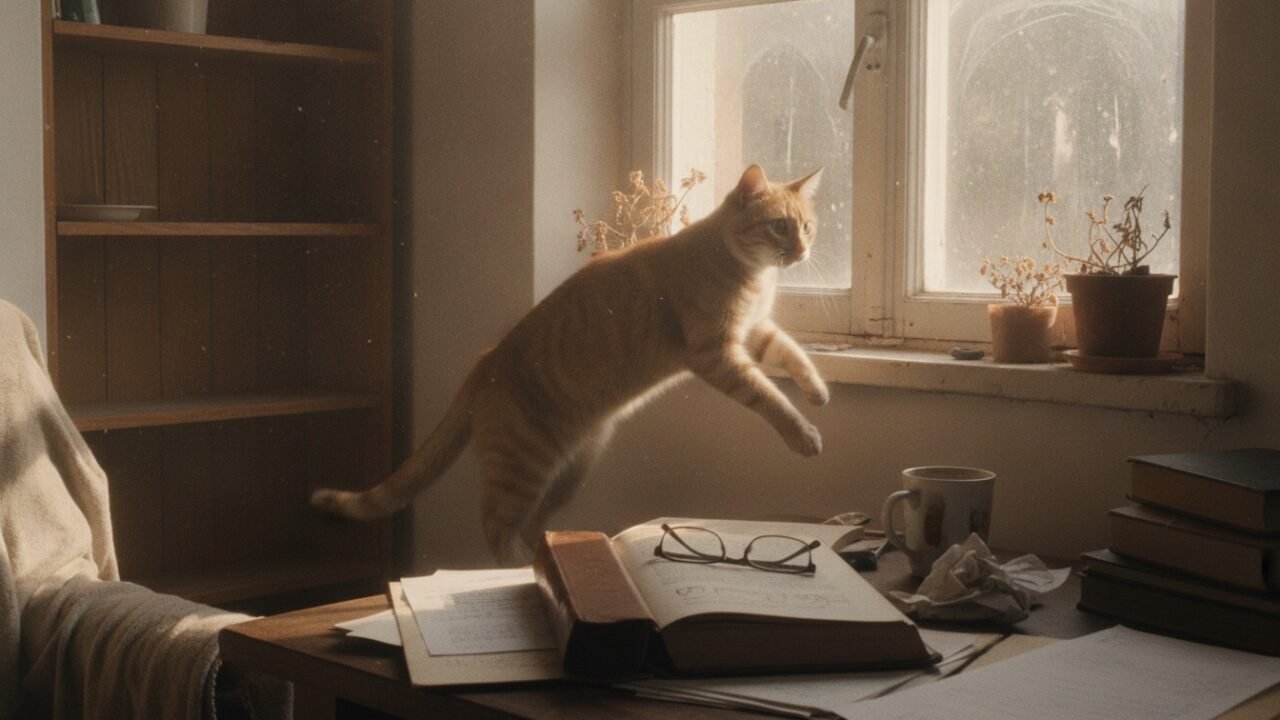
Vision is crucial for felines, allowing them to navigate their environment, spot prey or dangers, and interact with their surroundings effectively. Adapting their vision for nighttime gives them a major advantage in their natural habitat, turning them into efficient predators in low-light conditions.

The link between night vision and cat behavior is strong. Their ability to see in the dark shapes their activity, hunting habits, and even how they interact with their owners. Understanding this connection helps us better appreciate the complex nature of our feline companions.
Furthermore, studying cat night vision can even inspire human technology, such as improvements in night-vision cameras or motion detection. Nature has perfected this ability in cats, and we can learn a lot from it to develop innovative solutions.
Conclusion

In conclusion, feline night vision is a fascinating topic blending biology, evolution, and behavior. By understanding how this unique trait works, we can better appreciate the complexity and beauty of our pets. Night vision is just one of many compelling aspects of cats that invite us to discover more about these extraordinary animals.
Exploring cat vision reminds us of the importance of adaptation and specialization in nature. Every species develops unique traits to survive and thrive in its environment, and studying these adaptations teaches us valuable lessons about resilience and efficiency.
Frequently Asked Questions About Cat Night Vision
Can cats see in total darkness?
No. In complete darkness, a cat cannot see anything, just like a human. Their advantage is that they require far less light than we do (about six times less) to see clearly, thanks to the tapetum lucidum and the abundance of rod cells in their retinas.
Why do cats' eyes glow in the dark?
Because of the tapetum lucidum, a reflective layer behind the retina that bounces light back to make the most of it. That reflection is what we see glowing when dim light hits their eyes. It is the exact structure that powers their night vision.
Do cats see in color?
Yes, but in far fewer colors than humans and in more muted tones. They primarily perceive blues and greens, while struggling with reds. This is the trade-off for having eyes optimized for low light and movement rather than color and sharp detail.
🔍 Looking for something else?
If you want to read other articles similar to Why Your Cat Can See in the Dark (And the Myth Almost Everyone Believes) you can visit the category Curiosities.
Leave a Reply
More cat breeds!