

Fresh mud appeared in the garden overnight, and there they are: a line of tracks cutting across from the gate to the patio. Someone was here last night. The real question is who.
Almost everyone looks at the size and makes a call. Small means cat; large means dog. And almost everyone gets it wrong, because a Chihuahua leaves a tiny print while a Maine Coon leaves a surprisingly large one. Size is actually the worst indicator of all.
There is a test that takes just three seconds, works with a single print, and almost never fails. But first, let's clear up the myth that everyone repeats, which is only half-true.
Both tracks show four toes. Always.
Counting toes is completely useless: both cat and dog prints show four. End of story there.
The funny thing is that cats actually have five toes on each front paw. The fifth sits higher up, on the wrist, and doesn't touch the ground when walking—it's the equivalent of our thumb and only comes into play when grabbing things. So, a cat walks with five toes and signs with four. Their back paws have four and use four.
If you ever read that cats leave five marks, it's a myth copied a thousand times over. Except for one real exception: polydactyl cats, those born with extra toes, certainly can stamp five or six. They are quite common, and their tracks look like tiny baby mittens.
The X Test: Three Seconds and You’re Done
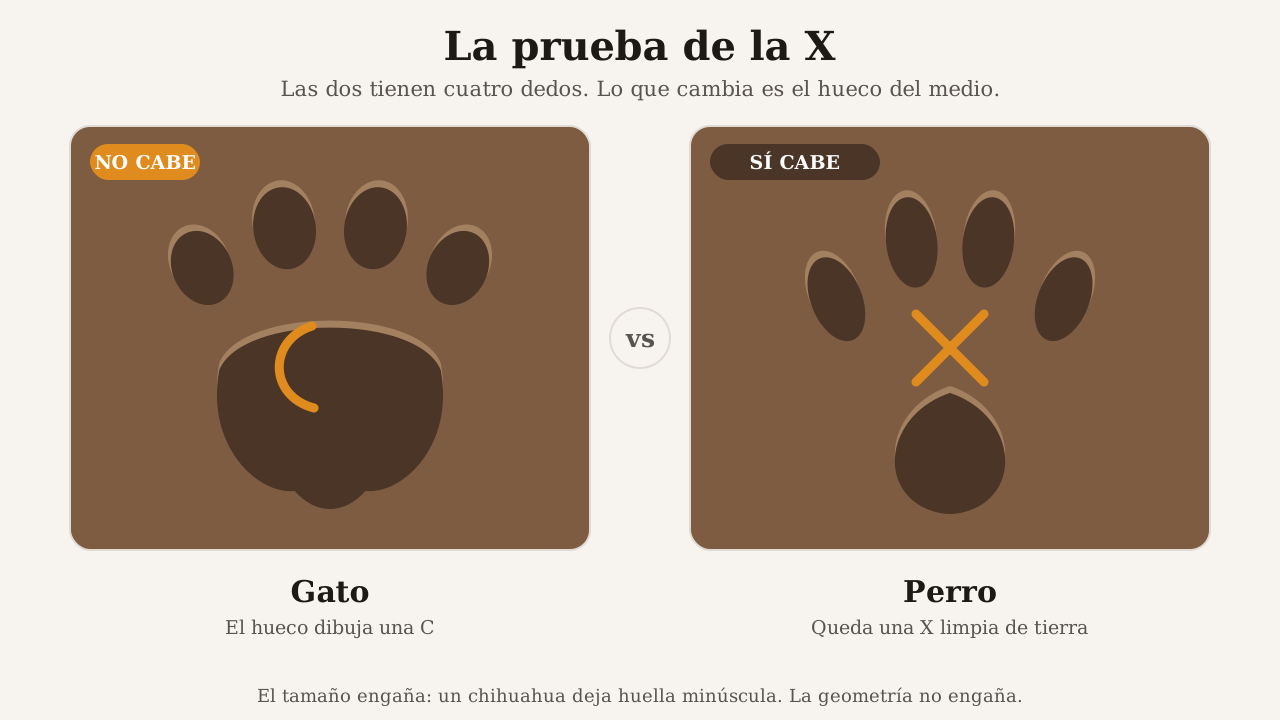
Look at the empty space between the toes and the large central pad, and try to mentally draw an X there. If the X fits cleanly without touching any pads, it's a dog. If it doesn't fit, it's a cat.

This works purely on geometry. A cat's central pad is massive in proportion to its paw—so much so that you could practically fit all four toes inside its surface. That pad crowds the space, leaving no room for an X; the remaining gap looks much more like a C, an arc hugging the toes. In a dog, the central pad is small and triangular, the toes sit further away, and a clear cross of mud opens up between them.
It's the exact same trick field trackers use to tell a mountain lion apart from a large dog. It works just as well in your backyard.
The Back Edge: An M vs. A Hump
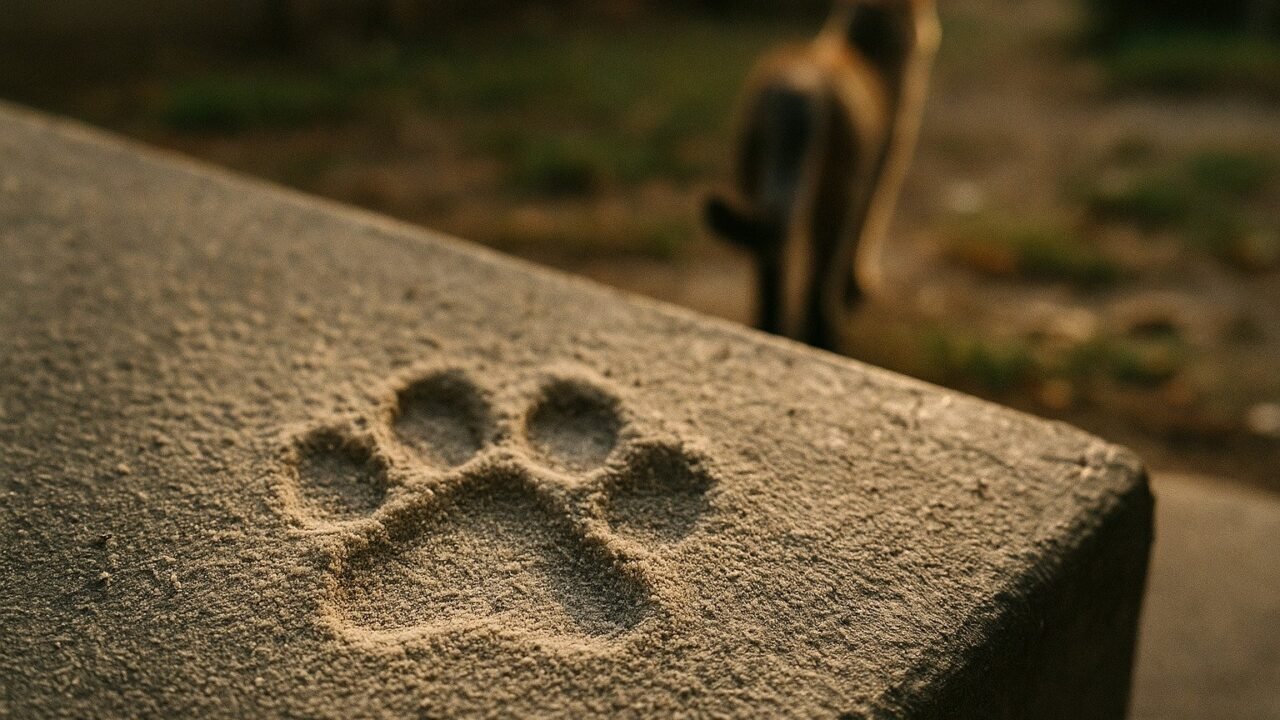
The second clue lies in the rear edge of that central pad. A cat's pad ends in three lobes, looking like a rounded M; a dog's pad ends in a single hump.
It's a tiny detail, which makes it the ultimate confirmation. You need fine mud, light snow, or settled dust to see it—it won't show up in gravel. Once you spot it once, you'll never unsee it.
And there's a third general shape detail: a cat's print is practically as wide as it is long, forming a circle. A dog's print is oval, longer than it is wide, with the two front toes almost aligned like twin teardrops.

Claws: The Popular Clue That Misleads Everyone
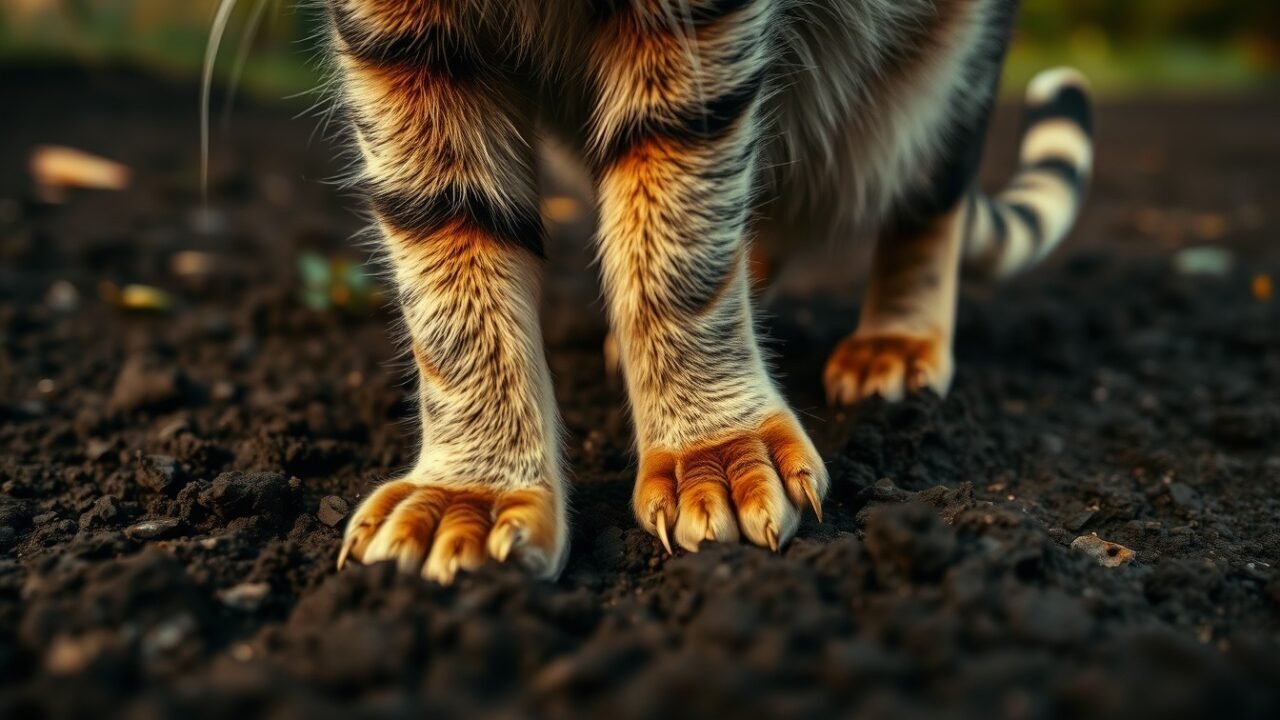
Sure, dogs usually leave claw marks while cats normally don't, since they keep theirs retracted while walking. But it's not a foolproof test, and it helps to know why.
A cat extends its claws the moment it needs traction: when sprinting, stopping short, cutting a sharp corner, or walking on very soft ground. A cat print with claw marks isn't rare; it's just a cat that was in a hurry. Conversely, a dog walking slowly on a hard surface might leave zero trace of nails.
That's why serious trackers look at geometry first—X or C, one or three lobes—and treat claws as secondary data. If the print tells you one thing by its shape and another by the claws, trust the shape.
Field Cheat Sheet: The 5 Factors Ranked by Reliability
| What to look for | Cat | Dog |
|---|---|---|
| 1. Inner space | A C arc: an X won't fit | A clean mud X |
| 2. Back edge | Three lobes, a rounded M | Just one, a single hump |
| 3. General shape | Round: as wide as it is long | Oval, longer than wide |
| 4. The complete trail | Narrow and almost in a straight line | Wide, scattered, zig-zagging |
| 5. Claw marks | Normally no... but possible | Usually visible... but not always |
If shape and claws contradict each other, trust the shape. Factor 5 is the one most people rely on, and the one that tricks them the most.
Stop Staring at a Single Track and Look at the Whole Trail
The biggest giveaway isn't in any single footprint: it's how they are arranged together. A cat places its hind paw almost directly into the exact spot where its front paw just stepped.
The result is a narrow, efficient trail, almost in a straight line, as if the animal were walking a tightrope. It's the hallmark of a hunter: fewer steps, less noise, fewer tracks left behind. Dogs don't do this. Dogs spread their paws out, leaving a wide, messy trail, and if they were sniffing around, the line zigzags all over the place.
Look at it while standing up, stepping back a couple of yards. A narrow, orderly trail is feline. A wide, chaotic one is canine.

Bonus Tip: How to Tell Left Paw from Right Paw
A cat's footprint is asymmetrical. One of the four toes sits slightly further forward than the others, much like your middle finger stands out from the rest of your hand.
Three more seconds and you'll know which paw made it:
- Look for the leading toe, the one sticking out further ahead than the other three.
- If it leans to the right → it's a right paw.
- If it leans to the left → it's a left paw.
With that, you can reconstruct the entire scene—where it entered, where it stopped, and where it headed off to. It's the closest thing to having a security camera made out of mud.
Frequently Asked Questions
How many toes show up in a cat track?
Four, just like a dog. Cats have five toes on their front paws, but the fifth sits high up on the wrist and doesn't touch the ground while walking. The back paws have four. Polydactyl cats are the exception and can leave five or more marks.
Do cat tracks really never show claws?
Normally no, but they can. Cats extend their claws when running, braking, turning sharply, or walking on very soft ground. That's why missing claw marks is a clue but not a confirmation: pad shape and the X test are far more reliable.
Can you tell them apart by track size?
It's the least reliable metric. Dog breeds vary so wildly that a small dog leaves smaller tracks than a large cat. Shape—round versus oval—and internal geometry are much safer bets than measurements.
Where are tracks best seen for identification?
In fine settled mud, shallow snow, damp sand, or fine dust. In gravel, grass, or very runny mud, the details of the lobes get lost and the X test stops being conclusive.
Sources: wildlife tracking guides describing the negative space test (an X in canids, a C in felines), the three-lobe rear edge of the feline pad, and the warning that claw marks aren't a definitive indicator since cats extend them to gain traction.
🔍 Looking for something else?
If you want to read other articles similar to Cat vs Dog Tracks: The 3-Second Test That Rarely Fails you can visit the category Curiosities.
Leave a Reply
More cat breeds!