

You searched for “cats with small ears” and many lists suggested Sphynx and Devon Rex. Here’s the awkward part: those two actually have huge ears. They’re among the breeds with the largest ears. One bad list was copied and pasted across the web. There’s something more serious too: among the breeds that truly have unusual ears, one’s charming fold isn’t just a cosmetic quirk — it’s cartilage that didn’t form properly, and not only in the ear. By the time you finish this article you’ll know how to tell them apart, and why the most famous of the bunch is banned in some countries.
The mistake: almost none of the commonly listed breeds have small ears
No domestic cat truly has “small” ears in absolute terms: what changes is shape, not overall size. A cat’s ear is a funnel built to swivel and pinpoint the rustle of a mouse under leaves. Evolution wasn’t going to shrink it because we find it cute.
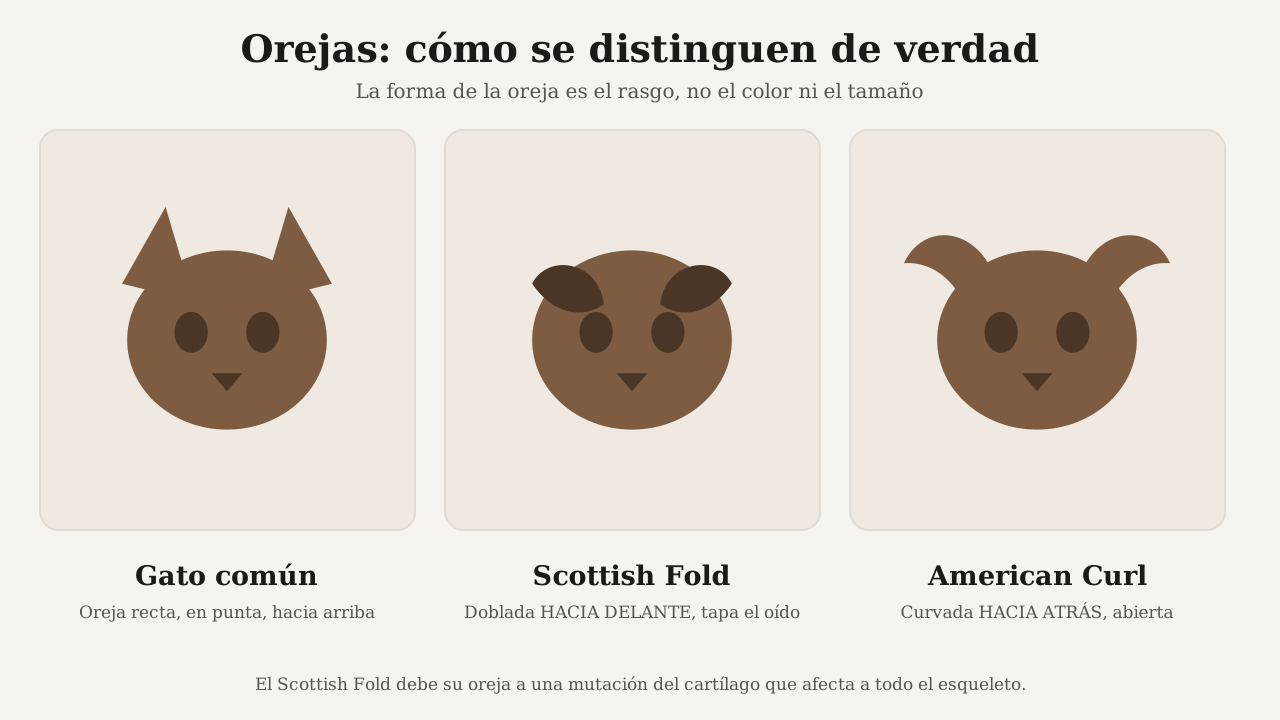
What you actually get are ears that are folded forward or curled backward. When folded they look smaller. That’s the whole trick. That’s also why many online lists mix breeds that don’t belong:
MYTH: “Sphynx, Devon Rex and Munchkin are small‑eared cats.”
REALITY: The Sphynx and Devon Rex have disproportionately large ears—that’s literally part of their breed standard. And the Munchkin is defined by its short legs, not its ears. If a site lists them as “small‑eared,” it copied without checking.
The breeds that really have a distinct ear trait fit on one hand: Scottish Fold and its long‑haired variety Highland Fold, the American Curl, the Ukrainian Levkoy and the Foldex. And they don’t all carry the same cost — not in money, but in welfare.
The explanation: two mutations that look alike but aren’t
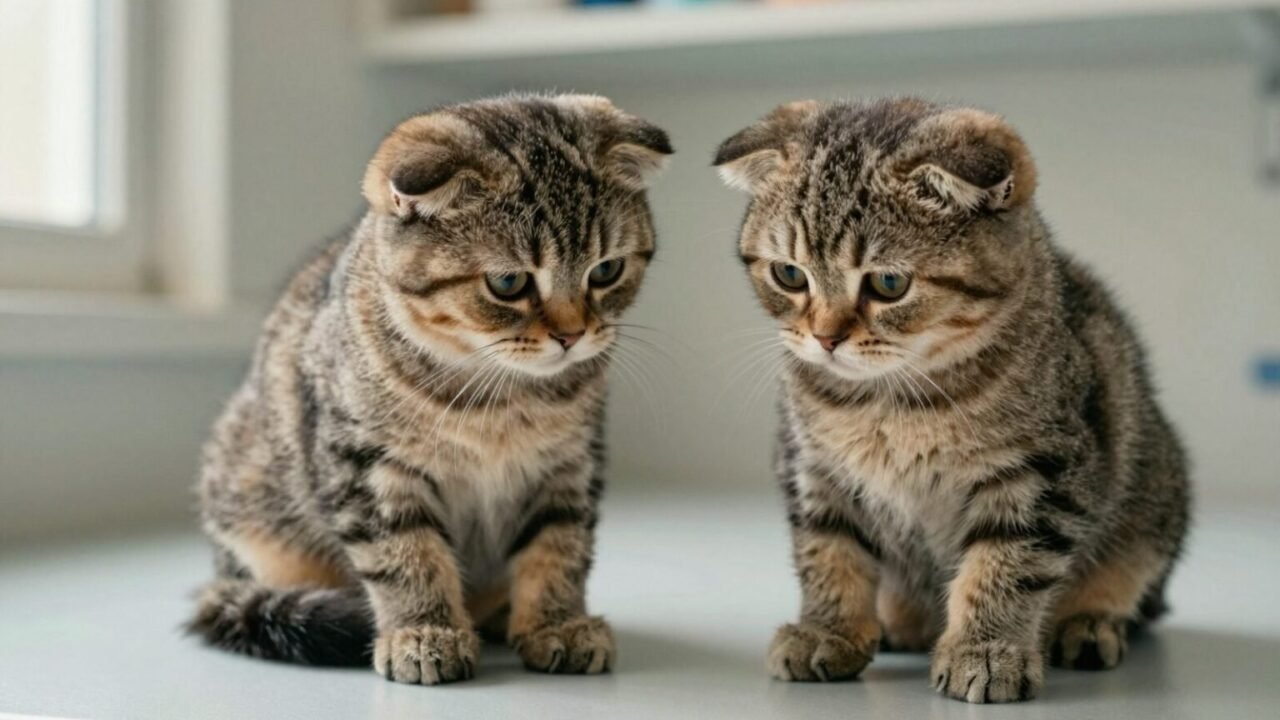
The American Curl and the Scottish Fold arrive at their unusual ears by opposite routes: one bends otherwise healthy cartilage, the other has defective cartilage throughout the body. This is the difference almost no one explains — and it’s the only one that really matters.
Both are born with straight ears. In the American Curl, between days 2 and 10 the ears begin to curl backward, as if styled with gel, and they settle by about four months. As far as veterinary science knows, that curl is not linked to any systemic disease. It’s a rebellious curl and nothing more.

In the Scottish Fold, the fold appears at around three to four weeks, and then the story takes a turn. The Veterinary Genetics Laboratory at UC Davis identified the cause: a dominant mutation in the TRPV4 gene, which makes an ion channel present in cartilage and bone throughout the entire body. The ear folds because its cartilage lacks normal stiffness. The problem is that the same soft cartilage is present in the ankles, knees and tail.
This condition is called osteochondrodysplasia, and here is the phrase that changes the conversation: according to International Cat Care and UFAW, every cat with folded ears has osteochondrodysplasia to some degree. It’s not a risk that affects just a few unlucky individuals. It’s the condition that produces the fold. A single copy of the mutation is enough.
Severity does vary. With one copy of the gene (heterozygous), the signs are usually milder and progress more slowly: stiffness, a thickened, less flexible tail, reduced willingness to jump, and arthritis that worsens with age. With two copies — what happens when two folded‑ear cats are bred together — skeletal deformities and lameness can appear within the first months of life. That is why Fold × Fold matings are banned by responsible breeders, and why several countries have outlawed breeding the variety outright. UFAW is blunt: stopping breeding from folded‑ear cats would remove this problem in a single generation.
What to do if you’ve fallen for one of these breeds
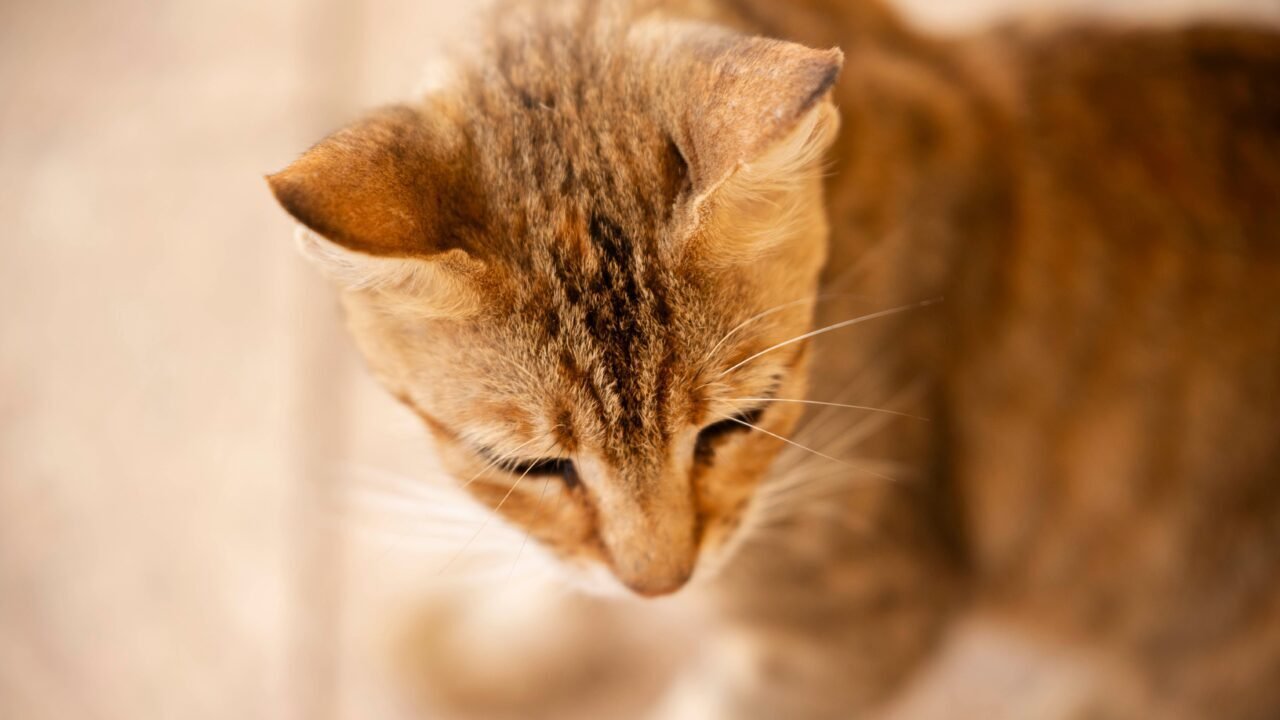
If you want the curious ear without the fine print, the American Curl is the short answer. But if you already have a Fold at home or plan to adopt one anyway, here’s what you can do:

- Watch the tail. It’s the earliest, easiest clue to check at home: gently stroke the tail. A tail that’s stiff, thickened or doesn’t flex like a normal cat’s tail is reason to consult a veterinarian.
- Notice what the cat stops doing. A cat that gives up jumping onto its usual perch, moves oddly on stairs or sits with hind legs splayed isn’t just “getting older”: it’s likely in pain.
- Ask for X‑rays, not promises. When talking to a breeder, the useful question isn’t “Are your cats healthy?” but “Can you show me the hip/hind‑leg X‑rays of the parents?” — and ensure neither parent has folded ears.
- Adapt your home. Ramps or steps to favorite high spots, a low‑entry litter box, soft beds and weight control: every extra gram loads joints that may already be compromised.
- Do not manipulate the ear. Don’t bend, stretch or “set” the ear on either Folds or Curls. In the American Curl the auricular cartilage is genuinely fragile and can be damaged.
And a note that applies to both breeds: folded or curled ears ventilate less well, so check the ear interior weekly for dark wax, bad odor or persistent scratching.
Scottish Fold vs American Curl: an honest comparison
| Scottish Fold | American Curl | |
|---|---|---|
| Ear | Folded forward | Curled backward |
| When it changes | Around 3–4 weeks | Between days 2 and 10 |
| Gene involved | TRPV4 (dominant) | Dominant, with no known associated pathology |
| Affects the skeleton | Yes, always to some degree | No |
| Breeding restriction | Fold × Fold (severe condition) | No health‑based restriction |
Frequently asked questions
Which breeds really have small ears?
None have truly small ears by size: their ears are folded or curled, which makes them appear smaller. The real breeds are Scottish Fold and Highland Fold (folded), American Curl (curled), Ukrainian Levkoy and Foldex. Sphynx, Devon Rex and Munchkin are not in this group.
Do all Scottish Fold cats have bone problems?
All cats with folded ears show osteochondrodysplasia to some degree, because the same mutation causes the fold. What differs greatly is severity and age of onset. Cats with two copies of the gene develop severe signs within months.
Does the American Curl have the same problems?
No. Its curl is not associated with known skeletal disease. It’s the sensible choice if what attracts you is the different ear. That said, its auricular cartilage is delicate: never force or bend the ear.
How do I know if my Scottish Fold is in pain?
Joint pain in cats rarely shows as a clear limp: it shows as things they stop doing. Fewer jumps, less play, a stiff tail, odd sitting posture or resistance to having the hind legs handled are red flags. If you see any, make a vet appointment; pain can be treated even if the underlying condition isn’t curable.
Do folded ears hear worse?
Hearing is usually normal: the fold affects the pinna, not the inner ear. The real issue is ventilation, because a folded ear traps more wax and moisture. Check weekly and clean only when directed by your vet.
If you’ve read this far it’s because you’re drawn to cats that look hand‑sketched. There’s another group that triggers the same impulse and hides a similar caveat: cats that never fully grow. We cover that in cats that never grow: the dream of the eternal kitten and the price no one tells you.
Sources: Veterinary Genetics Laboratory, UC Davis (TRPV4 c.1024G>T variant) · International Cat Care, Scottish Fold osteochondrodysplasia factsheet · UFAW, Genetic Welfare Problems of Companion Animals.
Written by Los Gatos Baby. We are not veterinarians: we compile and cite veterinary sources. This article is informational and does not replace professional advice.
🔍 Looking for something else?
If you want to read other articles similar to Cat breeds with 'small' ears: which really are—and the one that hides a health issue you can visit the category Cat breeds.
Leave a Reply
More cat breeds!