

You found it in the sink. Or stuck to the sleeve of your black sweater, which is where they always show up. A white, rigid whisker, surprisingly thick for coming from an eight-pound animal. And before throwing it away, you thought what everyone thinks: this means something.
I have bad news for folklore and very good news for your cat. That whisker on the floor doesn't foretell good luck or bad luck. It announces something much more interesting: that you dropped a precision instrument, and your cat has spent its whole life reading the world with it without you even realizing it.
What does finding a cat whisker mean?
Finding a loose whisker almost always means your cat is shedding fur completely normally. Whiskers follow their own growth and shedding cycle, just like the rest of the coat, only much slower: they detach one or two at a time and grow back.
The superstition of good luck is real as a superstition—there are popular traditions that keep the whisker as a charm—but it has no backing behind it, nor does it change depending on the cat's breed. A Siamese whisker doesn't bring any more fortune than a stray alley cat's whisker. What does change, and this actually matters, is how many you find and how often.
Why that hair is not a hair

A whisker is a sensory organ disguised as a hair. It's called a vibrissa, from the Latin vibrio, "to vibrate," and that word describes its job exactly: it doesn't touch, it vibrates.
Here is the detail that throws almost everyone off: the whisker itself doesn't feel anything. It's a dead antenna. What feels is down below, in the follicle, buried up to three times deeper than a regular hair root and surrounded by nerve endings. When a draft moves the vibrissa, that vibration travels down the shaft and wakes up the nerves at the base.
At that point, there are receptors called proprioceptors, which tell the cat's brain where every part of its body is in space. It's part of why a cat lands on its feet: it's not calculating it with its eyes, it's feeling it. Your cat doesn't walk in the dark. Your cat echolocates with its face.

The whiskers you didn’t even know existed

Your cat has whiskers in four areas, not just on its muzzle. On its nose it has between 16 and 24, arranged in orderly rows. But it also has them above its eyes, on its chin, and—the one almost nobody knows about—behind its front legs.
Those last ones are called carpal whiskers and they explain a scene you've seen a thousand times: the cat that catches something and, without looking at it, knows if it's still moving. With the prey between its paws, the cat's eyes can't focus well from so close up. The leg whiskers tell it what sight can't reach.
The ones on the muzzle come with another trick: they usually measure approximately the width of its body. They are a biological tape measure that tells it "I fit here" before committing the rest of its body. When your cat sticks its head into a bag and stops, it's not hesitating. It's measuring.
When a whisker on the floor actually is a sign
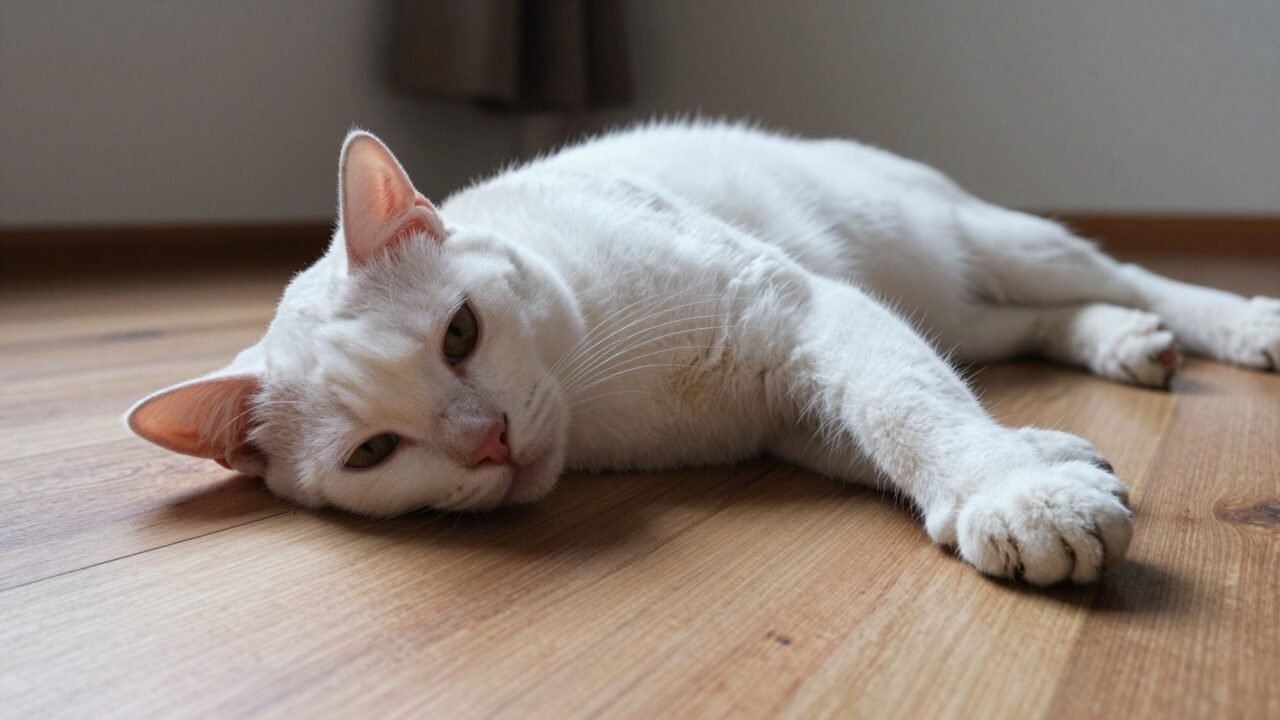
A loose whisker every now and then is routine; several at once, or broken and frayed whiskers, deserve a vet checkup. The difference between normal and concerning isn't in the whisker itself, it's in the quantity and what accompanies it.
It's worth consulting when the loss is accompanied by pimples or scabs on the chin—feline acne shows up right in that area—by irritated skin around the follicles, or by a sudden change in the home environment. A move, a baby, a new cat: stress takes a toll on fur too.
And what you should never do, no matter how symmetrical you think it would look: trim them. It doesn't hurt, and that's precisely the problem—it seems harmless. A cat with trimmed whiskers gets disoriented, misjudges gaps, and loses information it can't replace with its eyesight. They do grow back, but it can take weeks or even months. Here we explain exactly how long it takes and what happens in the meantime.

What to do with the one you found
Keep it if it makes you happy: it's of no use to your cat once it's shed, and it won't reattach. It's keratin, the same protein as your nails, so it keeps without any special care.
But if you want to get something useful out of the find, do this instead: look at it closely before putting it away. A healthy whisker sheds whole, with the fine tip intact. One that appears broken in half, with a blunt or brittle end, is telling you that it snapped instead of dropping out naturally. At that point we're no longer talking about shedding: we're talking about something damaging it, and it's worth figuring out what.
That's the only superstition worth adopting. Finding a whisker doesn't bring luck. It brings information.
Frequently Asked Questions
Is it bad for my cat to lose whiskers?
No, if it's one by one and sporadically: it's part of the natural replacement cycle. It becomes a reason for a veterinary visit if it loses several at once, if they appear broken or frayed, or if there is skin irritation around them.
How many whiskers does a cat have?
Around 16 to 24 on the muzzle, plus the ones above its eyes, on its chin, and behind its front legs. The exact number varies between individuals and breeds.
Does it hurt if I cut my cat's whiskers?
It doesn't hurt, because the whisker shaft has no sensitivity. But it leaves the cat without part of its orientation system: it can become disoriented, misjudge tight spaces, and feel more insecure until they grow back.
Sources: VCA Animal Hospitals (vibrissae and proprioceptor function) · Cats.com, vet-reviewed guide (regrowth after falling out or trimming). At Los Gatos Baby we are not veterinarians: we gather what the sources say and tell you when it's a good idea to consult one.
🔍 Looking for something else?
If you want to read other articles similar to What Finding a Cat Whisker Means (And the Sign Almost No One Knows How to Read) you can visit the category Curiosities.
Leave a Reply
More cat breeds!