

It's Christmas. You dress your cat in a reindeer costume because it looks adorable. And it is.
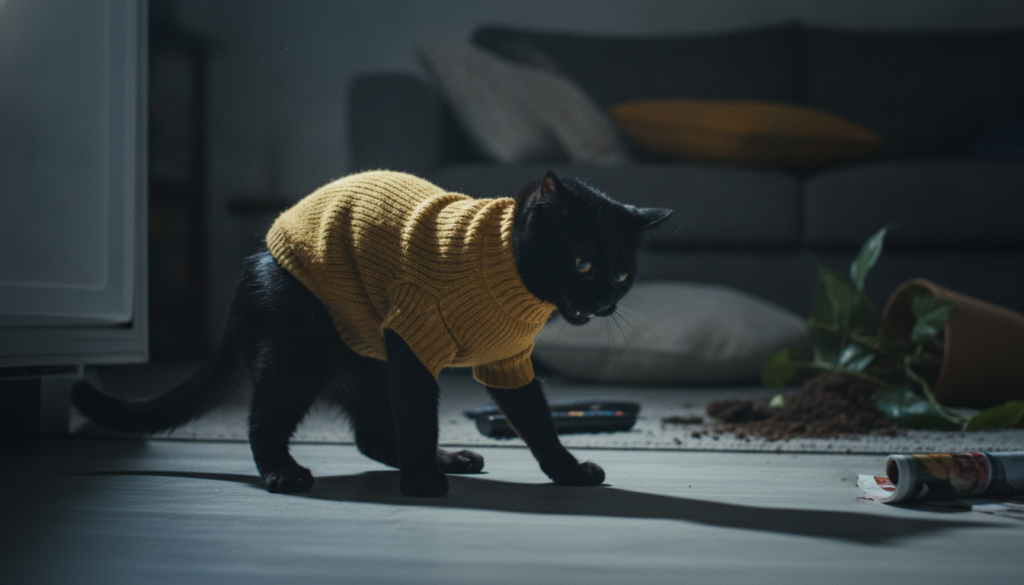
But there's something probably no one has ever explained to you: that stillness isn't obedience. It's a genuine biological response — and to understand it you have to follow, step by step, a very specific neural pathway.
The lie of anthropomorphizing
We anthropomorphize our pets out of love: "if I'm cold, he's cold". It's the logic that the pet fashion industry exploits without telling you the rest of the story.
But cats don't primarily read the world with their eyes. They read it with their face.
The science of whiskers: the exact signal pathway
Each whisker — each vibrissa — grows from a follicle with its own blood supply and a high concentration of nerve endings, far greater than that of a regular hair.
From there it ascends to the trigeminal nucleus, in the brainstem, where the cat's brain literally maintains a spatial map of each whisker on its face. That map then passes to the thalamus, and finally reaches the somatosensory cortex, where groups of neurons are organized into "barrels" — each corresponding to a specific whisker.
It's a system built to sense distance, texture, and airflow. When a garment covers or presses that area, it doesn't just bother "a little": it disrupts one of the animal's finest information pathways for knowing where it is.

The domino effect of chronic stress, minute by minute
Minute 1. The fabric covers part of the body and brushes the side whiskers. The cat stays still — not out of calm, but to recalculate with the information it has left.
Minute 3. When it doesn't receive the usual signals, the nervous system interprets the situation as uncertain. Alert signals start: dilated pupils, ears turned sideways.
Minute 6. If no one removes the garment, the cat moves from alertness to defensive immobility — the whole body goes rigid. Weeks later, if it repeats, that same cat begins to anticipate the feeling as soon as it sees the garment or the hands reaching for it.
When clothing does help: a guide to three real cases
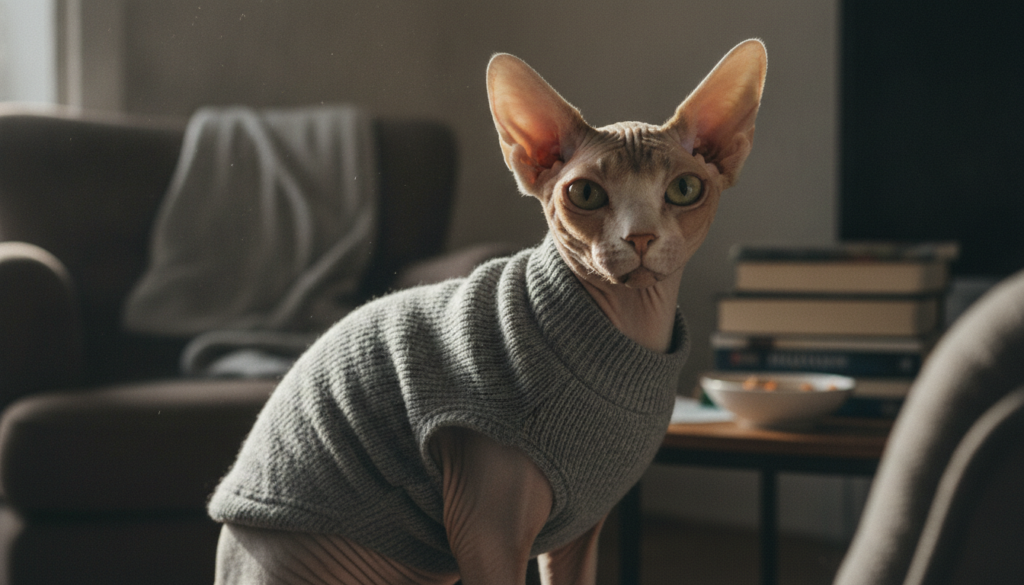
1. Hairless breeds (Sphynx and similar). Without the fur layer that insulates against cold, they lose body heat much faster. Look for soft fabric, without thick seams, that covers the torso without constricting the legs.
2. Post‑operative recovery. The recovery suit replaces the Elizabethan collar without blocking the facial whiskers or peripheral vision. Always choose one with a rear closure that the cat can’t remove on its own.

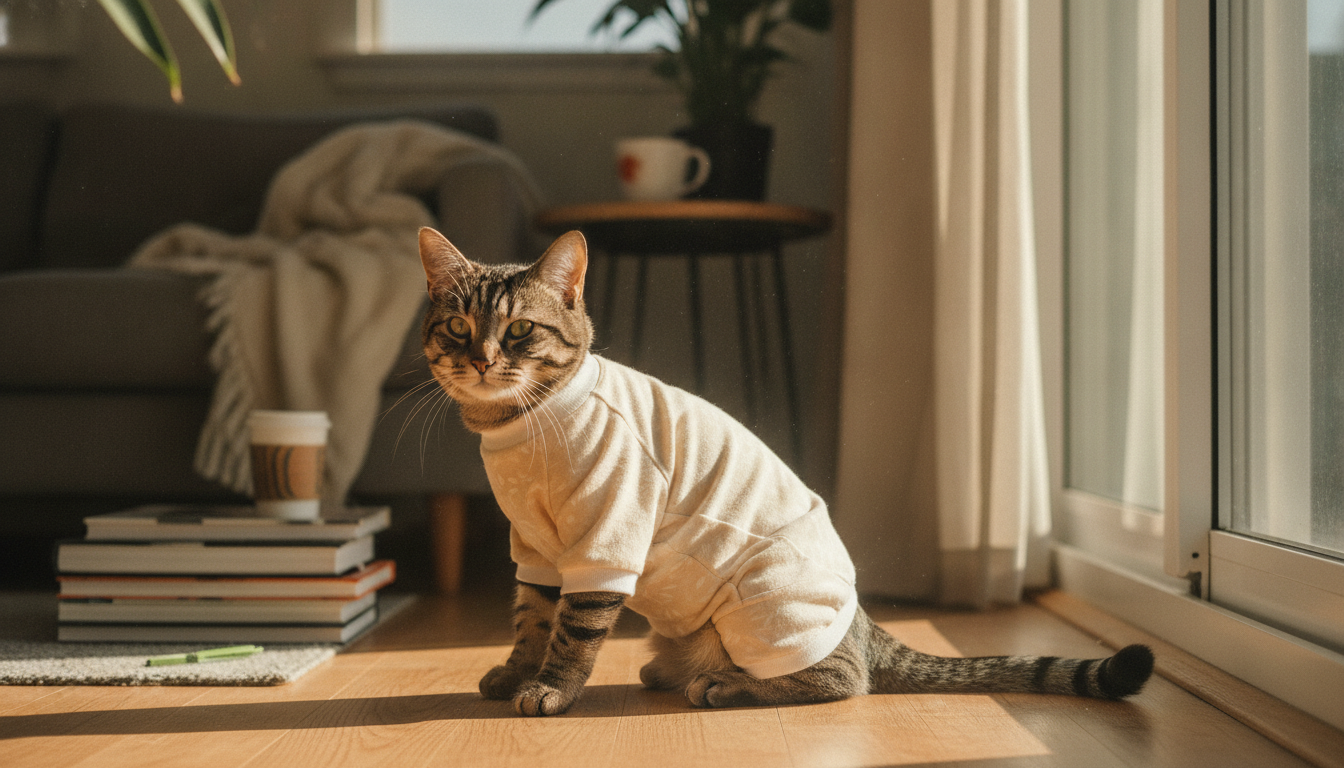
3. Proven extreme cold. It’s not just “a bit chilly” at home: real, prolonged cold in very senior cats or those with medical difficulty regulating temperature. Here, a lightweight garment can make a real difference.
In these three specific cases, you’re not dressing up your cat. You’re giving the kind of care its body—not fashion—is asking for.
How to tell if your cat is fine or just frozen
- Walks, grooms normally, seeks contact → it’s tolerating the garment well.
- Stays still, crouched, ears back → take it off immediately, without dramatizing the moment.
- Always start with 2–3 minutes under supervision, never a whole afternoon of photos.
Now that you know the exact path that signal takes in its head, you can keep taking those photos you love — with a cat that’s truly enjoying them with you.
Frequently Asked Questions
Do coated cats need clothes in winter?
Generally, no.
What exactly are vibrissae?
Whiskers and sensory hairs connected, via the trigeminal nerve, to a dedicated map in the cerebral cortex.
Does a suit always replace the Elizabethan collar?
Not always, it depends on the wound — consult your veterinarian.
Can I leave clothes on them all day?
Not without supervision, especially at first.
Sources
- Williams, C.J. & Kramer, E. (2010), via Neuroethology Blog, University of Toronto.
- Dr. Elizabeth Mauldin, U. Pennsylvania School of Veterinary Medicine (via PetMD).
- Dr. John Berg, Cummings School of Veterinary Medicine, Tufts University (via Rover).
Los Gatos Baby Editorial Team. We are not veterinarians or certified ethologists: to decide on the correct equipment after surgery or for a hairless cat, always consult your veterinarian.
🔍 Looking for something else?
If you want to read other articles similar to Cat Clothes: What Their Body is Silently Screaming at You you can visit the category Health & Care.
Leave a Reply
More cat breeds!