

If you're reading this while your cat is actively giving birth right now, start here
Call your vet immediately if any of the following occur:
- Strong, continuous contractions for 20–30 minutes without a kitten coming out.
- A visible kitten stuck in the birth canal.
- Dark green or black discharge before the first kitten is born.
- Foul-smelling discharge or heavy red bleeding.
- The cat is weak, collapsed, crying out in pain, or vomiting repeatedly.
- More than 24 hours of labor without any kittens born.
- More than 70 days of gestation without labor starting.
Do not attempt to resolve an obstructed labor at home. Call, describe what you see, and follow instructions.
It's 4:00 AM, your cat has been in her nesting box for half an hour, and you're holding your phone, wondering if you're overreacting or waiting too long.
The answer you need isn't just how many hours labor lasts. It's how much time can pass without anything happening before it stops being normal. That is what decides whether you call the vet or wait.
How long does cat labor last?
A complete birth usually wraps up in a few hours, but you should prepare for the entire process to take up to nearly 24 hours. Labor has two distinct stages, and confusing them is what causes the most panic.
First stage: 6 to 12 hours. You won't see contractions yet. Instead, you'll see a restless cat pacing, digging at bedding, hiding, panting, licking herself, going in and out of the litter box, and refusing food. Inside, the kittens are moving into position. This stage can take longer for first-time mothers.
Second stage: delivery. This is when visible contractions and active pushing begin. The first kitten should arrive within 30 minutes of hard pushing starting. Subsequent kittens typically arrive every 10 to 60 minutes.
Breed doesn't change these numbers. The myths floating around—that Siamese cats take 6 to 12 hours or Sphynxes give birth in a flash—aren't backed by facts. What truly matters is litter size, whether she's a first-time mother, and her overall health. There is one real anatomical exception: flat-faced breeds like Persians have kittens with large heads and short bodies, which can increase the risk of a difficult birth.

The pause that scares everyone and is usually normal
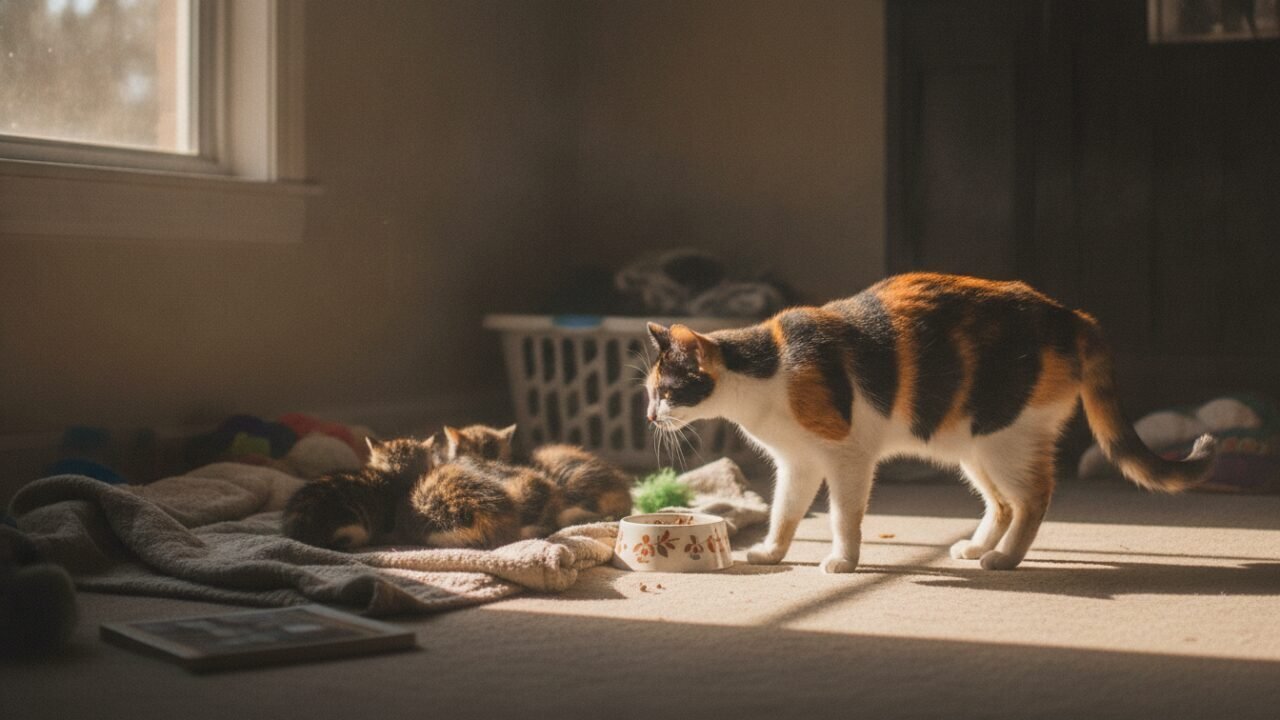
There is a phenomenon known as interrupted labor, and in cats, it's common enough to be considered normal. The cat stops pushing, relaxes, nurses the kittens already born, grooms herself, and even eats—even though she still has more kittens inside.
That pause can last 24 or even 36 hours. Afterward, she resumes pushing and delivers the rest of the litter normally. Many people rush to the emergency vet unnecessarily because of this, while others ignore a real emergency thinking it's just a normal pause.
The difference between a good pause and a bad one isn't in the clock. It's in how she looks. A calm resting pause checks all of these boxes at once:
- She is calm and alert, not panting from exhaustion.
- She is not pushing. No contractions, no straining.
- She is caring for, licking, and nursing the newborns.
- There is no heavy bleeding or foul-smelling discharge.
- She is breathing normally.
If every item on that list is true, it's just rest. The moment even one of them fails—especially if she starts pushing hard again with no results—it stops being a pause and becomes an emergency.
The rule of the three clocks

Remember three key figures and you'll always know when to make the call:
20 to 30 minutes of strong contractions without results. This is the most critical and urgent sign. Intense, sustained pushing without a kitten arriving suggests an obstruction.

More than 2 hours between kittens when there are no contractions, knowing there are still kittens left to be born. If she is also actively pushing, this window shrinks drastically: do not wait for hours in that scenario.
24 hours of total labor duration. Past this point, even if everything seems calm, the process has simply been going on for too long.
The discharge color detail you need to understand

Dark green or blackish discharge before the first kitten is a red flag: it can indicate that the placenta is separating and the kitten is at risk. That means an immediate call.
However—and this nuance matters greatly—once the first kitten is born, seeing that greenish color is completely normal, as it accompanies the placenta. The exact same color means opposite things depending on when it appears. That's why it helps to write down the birth time of each kitten: it saves you from second-guessing.
What you should do (which is surprisingly very little)
Almost nothing, and that is the right answer. Most cats deliver perfectly on their own, and human interference stresses them out. Your job is to observe from a distance, quietly, and in dim lighting.

There is only one situation where you should step in without hesitation: if the mother does not break the sac covering the kitten within about two minutes. If that happens, gently tear the membrane with your fingers, tilt the kitten's head slightly downward, and rub it with a towel to clear its nose and mouth and stimulate breathing.
Keep clean, light-colored towels on hand—they make it easy to spot any discharge colors—and have your emergency vet's number saved ahead of time, rather than searching for it at 4:00 AM. Keep a notepad to track the times: when heavy pushing started, when each kitten was born, and how many placentas came out. If you end up calling the vet, that information is worth more than any description.
Frequently Asked Questions
How much time can pass between one kitten and the next?
Typically, 10 to 60 minutes. A longer pause can be normal if the cat is calm and not pushing (interrupted labor, which can last up to 24–36 hours). If it exceeds 2 hours without contractions, or if she pushes hard with no results, you need to call the vet.
Does the breed change the duration of labor?
Not significantly. Litter size, whether she is a first-time mother, and her overall health play a much larger role. The main exception is physical conformation: brachycephalic breeds like Persians have a higher risk of dystocia due to the disproportion between the kittens' heads and the mother's pelvis.
How long is a cat's gestation period?
Around 65 days, or about nine weeks. Exceeding 70 days without labor starting is a reason to consult a veterinarian.
Should I cut the umbilical cord?
Usually, the mother does this herself, and you don't need to interfere. The only thing that cannot wait is the amniotic sac: if she doesn't remove it within about two minutes, open it yourself and stimulate the kitten with a towel. For anything else, consult your vet before handling.
Sources: Merck Veterinary Manual (dystocia criteria: interval over 2 hours without contractions, labor lasting more than 24 hours, dark green or foul-smelling discharge as a sign of placental separation) · VCA Animal Hospitals (interrupted labor as a normal phenomenon in cats and the 20-minute heavy straining rule) · International Cat Care.
At Los Gatos Baby we are not veterinarians, and this article does not replace professional veterinary consultation. If you have any doubts during labor, call your vet: calling when unnecessary costs nothing, but waiting when you shouldn't can cost a lot.
🔍 Looking for something else?
If you want to read other articles similar to How Long Does Cat Labor Last? The 3 Key Numbers to Know you can visit the category Health & Care.
Leave a Reply
More cat breeds!