

China has been living alongside cats for five thousand years. Ancient Egypt turned them into gods; Persia gave its name to a breed; Thailand exported the Siamese. And China, with all that head start?
Practically a single native breed. Just one. And it is not even ancient: it was only formally bred starting in 2003.
Behind that void lies a story much better than any breed catalog: China domesticated a completely different cat from the rest of the world… and then lost it.
The Only True Chinese Breed is Called the Li Hua
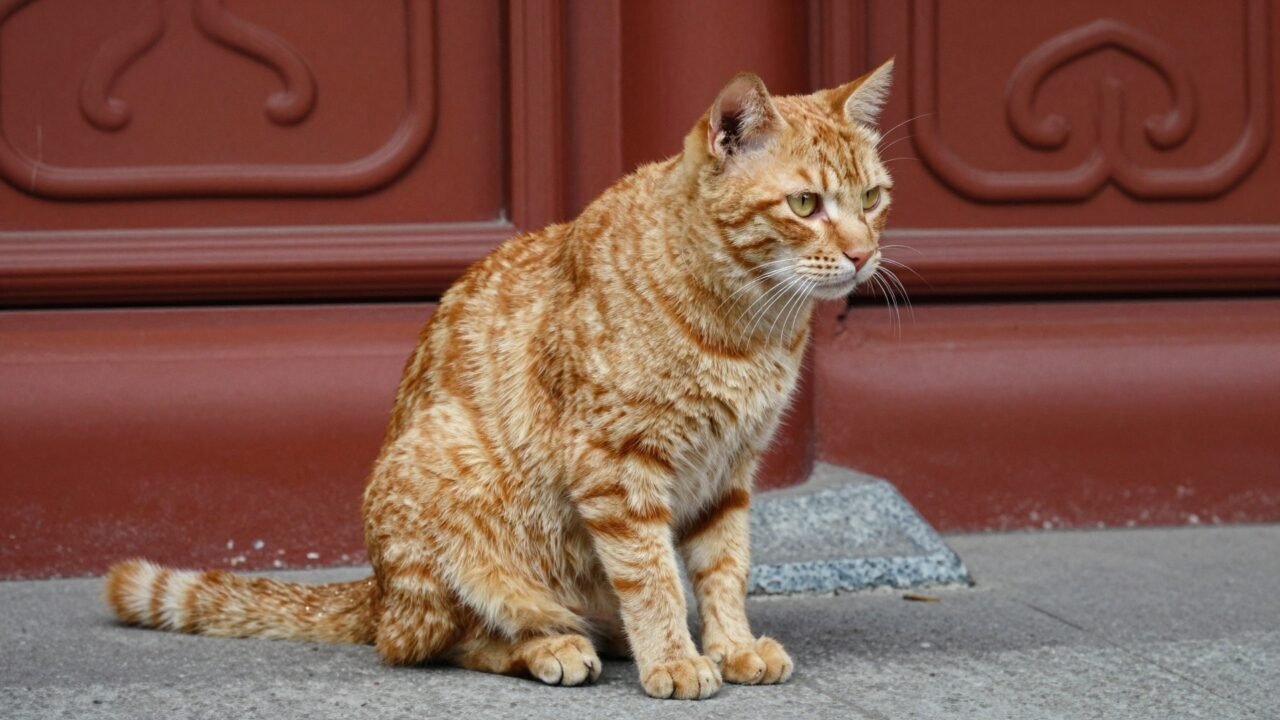
If anyone tells you about Chinese breeds, the short answer is the Li Hua (狸花猫), also called the Dragon Li. It is a robust, rectangular cat with a brown-tabby coat featuring broken stripes, almond-shaped eyes ranging from green to amber, and a gaze that still feels somewhat wild.
Its name literally means "fox-flower cat" or leopard cat-patterned cat. Remember that detail, because it will make sense in a moment.
This is not a parlor pet manufactured by breeders: it is a native population that roamed free across China for centuries, hunting rats in barns and sneaking into folklore tales. Twenty years ago, someone decided to give it a standard and paperwork. It was first presented in Beijing in 2003, and in 2010 the Cat Fanciers' Association accepted it for exhibition. Today, it remains rare outside of China and is not recognized as a standardized breed by major international registries.

It matures slowly, taking up to three years, which is unusual for cats. A two-year-old Li Hua is still, at heart, a massive teenager.
The Chinese Breeds People Will Try to Sell You That Don’t Exist
Let's be direct here: if you read about the "Beijing cat" or the "Shandong mountain cat" as feline breeds, you're being fed a fairy tale. They do not appear in any serious registry.
It's a mistake copied from blog to blog because it sounds plausible: China is huge, it has famous cities, so it must have breeds named after them. Along the way, a complete backstory is invented for them—trips to England, crosses with Persians and Siamese—that has never been documented anywhere.
There is another, more understandable confusion: many people assume the Siamese and the Burmese are Chinese. The Siamese comes from Thailand, the ancient kingdom of Siam. The Burmese comes from Myanmar (formerly Burma). They are neighbors to China, not Chinese.
The Cat China Domesticated and Then Lost
Now for the good part. At the Neolithic village of Quanhucun, dating back about 5,300 years, researchers found small feline bones living alongside farmers. For a while, this was believed to be proof that China had domesticated cats on its own.
Then came detailed bone shape analysis and ancient DNA testing, and the result was even better than the original hypothesis: those were not common cats. They were leopard cats (Prionailurus bengalensis), a wild species completely distinct from the ancestor that gave rise to all domestic cats worldwide.

In other words: while the Middle East was beginning to live alongside the African wildcat, China was doing the exact same thing on its own with another animal entirely. An independent experiment, with a different species, thousands of miles away.
And here is the ending almost nobody tells: that lineage did not survive to the present day. Leopard cats lingered around Chinese settlements for millennia, but they were eventually replaced by the domestic cats arriving from the West. Today, all cats in China genetically descend from the same ancestor as the rest of the planet. Not a single drop of the cat China first domesticated remains in the pets sleeping on Shanghai sofas today.
Remember what "Li Hua" means? A leopard cat-patterned cat. The only breed name China gave to the world is, deep down, a tribute to the cat it lost.
And the Rarest Chinese Cat of All Isn’t Even Domestic
There is a feline that is exclusively Chinese and that almost no one has ever seen: the Chinese mountain cat (Felis bieti), which inhabits the Tibetan Plateau. It is wild, scarce, and elusive.
It is not a pet, it is not bred, and it shouldn't be. It is sometimes mentioned as a possible ancestor of the Li Hua, but this is a popular attribution without solid backing, so it is best to take it as a charming legend rather than a hard fact.

So, why does China have so few breeds?
Because feline breeds, as we understand them, are a recent and fairly Western invention: they were born from Victorian cat shows, breeding clubs, and written standards. China had cats for millennia without needing to catalog them.
The Chinese cat was a worker, not a collector's item. It hunted in the barn and protected the harvest. No one kept track of its pedigree because no one cared about pedigrees—they cared if it did its job.
The fact that a country with five millennia of cats has only one breed does not speak of feline poverty. It shows that over there, the cat never needed a last name to have value.
Frequently Asked Questions
What cat breed originates from China?
The Li Hua or Dragon Li, a golden tabby cat developed from a native Chinese population. It was introduced as a breed in 2003 and accepted for exhibition by the CFA in 2010, though it is not recognized as a standardized breed by major international registries.
Is the Siamese cat Chinese?
No. The Siamese comes from Thailand, the ancient kingdom of Siam. The Burmese comes from Myanmar. Both are often mistaken for Chinese breeds due to geographic proximity.
Does the "Beijing cat" breed exist?
It does not appear in any recognized feline registry, nor does the "Shandong mountain cat." These are names circulating on the internet without documentary backing.
What is the personality of the Li Hua like?
It is described as having a calm temperament, excellent hunting skills, and slow maturation, reaching full adult shape around three years of age. It is strong, muscular, and retains a solid instinct, so it appreciates play and mental stimulation.
Sources and Further Reading: The study published in PLOS ONE by Vigne et al. identifying Neolithic feline remains in China as leopard cats, and documentation from the Cat Fanciers' Association regarding the Li Hua and its 2010 exhibition acceptance.
🔍 Looking for something else?
If you want to read other articles similar to Chinese Cat Breeds: Only One Really Exists (And the Cat China Domesticated and Lost) you can visit the category Exotic.
Leave a Reply
More cat breeds!